Showing posts with label Cook. Show all posts

Thursday, June 12, 2014

Solar Box Cookers: Using the Sun To Cook Your Food

Solar box cookers are the be-all and end-all when it comes to harnessing the sun to cook food.  They run solely on the sun's rays which makes them the ideal cooking solution for many areas where electricity and fuel aren’t options.  They’re also wonderful for outdoor cooking because they pose little risk of forest fire and are much lighter than hauling fuel around in your backpack.

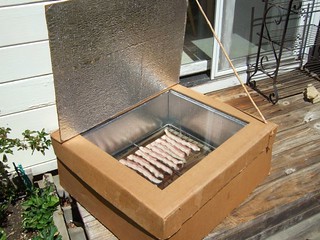
Solar Bacon
Solar Bacon (Photo credit: Earthworm)
How Solar Cookers Work

There are actually more than fifty different variations on the solar cooker theme.  However, they typically fall into three basic designs or design principles.  These include:

* Concentrating sunlight.  In this type of device the sunlight is concentrated or focused by some type of reflective metal or a mirror.  The heat and energy from the sun then becomes concentrated and much more intense. 

* Converting light to heat.  In this type of design the solar cooker makes use of heat-absorbing elements, like the color black, to amplify the cooking process.  One example would be to coat the inside of the cooker with black paint or to use a black material to collect the sunlight and convert it into heat.  If you’ve ever worn a black shirt on a sunny day, you know how effective this is. 

* Finally, a third type of design traps heat by using a clear device, like a lid, to keep the heat inside and thus to use it to maximize cooking.

Of course, some designs take advantage more than one of these solar cooking elements to really maximize the sun’s effects.  A solar box cooker is one of the most basic types of solar cookers and can be made at home with few resources or technical skills.

Ingredients for a Solar Box Cooker

If you’re going to make a solar box cooker at home (and why not!) then you’ll need to collect a few things.  They include:
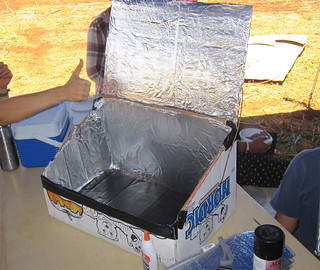
Box cooker in the works
Box cooker in the works (Photo credit: EBKauai)
* Two cardboard boxes.  One box should be larger than the other and ideally the bigger the better because it’s awfully difficult to make much in a children’s shoe box.  There should also be about ½ inch of space between the two boxes all the way around.

* One sheet of cardboard for the lid.  You’ll want it to be several inches larger than the top of your largest box.  So for example if your box is 10X10 you’d want your cardboard to be around 13x13.

* A roll of aluminum foil.

* Flat-black, non-toxic, spray paint or tempera paint. 

* White glue, non-toxic.

* A Reynolds oven cooking bag or a sheet of glass.  The oven bags are ideal because they’re inexpensive, durable, and easy to find.  They’re also designed to withstand up to 400 degrees Fahrenheit. 

That’s it; that’s your supply list.  For more information on building a solar box cooker, see related articles below. Solar box cooking can be a fun way for your children to learn the amazing powers of the sun and to learn a bit about solar energy.  You can also take advantage of this wonderful device and cook outdoors when the weather permits.  You’ll save energy and have fun in the process!

Related Articles on Solar Box Cookers:
Enhanced by Zemanta

Thursday, July 11, 2013

Five Cooking Tips to Save Energy in the Kitchen

We’re all looking for ways to save money and consume fewer resources for a greener planet. Some of the ways to save energy, like turning the thermostat up or down, seem fairly obvious and don’t feel as if we’re doing enough.  One great way to amplify your efforts is to look room by room at how you can save energy.

If you've been reading our Cooking From Scratch blog, you know how much I love to cook! So today we're going to talk about what is perhaps the most energy-hungry room in your home - the kitchen.  Here are five cooking tips to save energy in the kitchen:

Large and small skillets
Large and small skillets on different sized burners. (Photo credit: Wikipedia)
#1.  Use the right size pan for the cooking job and make sure to match it to the right sized burner.  It may sound silly but you can waste a lot of time and energy trying to boil a giant-size pot of potatoes on an itty bitty burner.  And you can waste a tremendous amount of energy warming up a small pan of sauce on a giant burner.  If you can see more than a half inch of overlap, either the pan overlapping the burner or the burner overlapping the pan, see if there’s a better fit. 

Additionally, if you only have to boil three potatoes you don’t need to get out the giant 5-quart pot.  And if you have to boil twenty potatoes, you absolutely do need a large pot with an appropriate amount of water – just enough to cover the tops so you don’t have to spend too much time and energy heating all that water.

#2.  Don’t preheat your oven.  Have you ever been pressed for time and just shoved that tray of chocolate chip cookies in an oven that hasn’t been preheated?  What happened?  Presumably you may have had to add one or two minutes to the cook time but it certainly didn’t add ten minutes or more to the cook time.  With many ovens it takes 10-15 minutes to warm up to 350 degrees, and that’s wasted energy.  Don’t waste your time and energy preheating - get those cookies in the oven and enjoy!

#3.  Use smaller appliances for smaller jobs.  If you’re making an open-faced sandwich, warming up leftovers or eating those frozen and ready-to-cook cookies, then skip the oven and use your toaster oven instead.  It uses less energy to heat up - and it also won't put off as much heat into the house so you won't have to run the a.c. as much.  Additionally, if you use a microwave, it can be used to steam, reheat and even to make eggs, melt chocolate and warm up canned foods in much less time and with much less energy.

English: A pressure cooker with a simple regul...
A pressure cooker with a simple regulator and an oval lid. (Photo credit: Wikipedia)
#4.  When you are making soups, stews and even some barbecue recipes or roasts, consider using a slow cooker instead of cooking them for hours on top of the stove.  Slow cookers use less energy and you can cook your meals during low energy times in your home. For example, if you’re using the air conditioner during the day and also cooking, you’re going to make your a/c work harder because your cooking will add heat to the home.  However, if you can cook your roast overnight when your a/c isn’t running as hard then you’re saving energy. It also won't heat up the house as much as using the stove or oven.

#5.  Grab your mother’s pressure cooker and embrace it for its amazing power to cook foods in a tenth of the time!  However, if your mother’s old pressure cooker scares the heck out of you, the newer models are significantly safer, and easier to use. 

You can save a tremendous amount of energy focusing your attentions and habits on one room at a time.  And what better place to start than in the kitchen, the core of your home and probably your biggest user of energy? 

Enhanced by Zemanta

Wednesday, July 4, 2012

Try These New Raw Food Recipes

If you've started eating raw foods and changing your lifestyle, you’re feeling better, finding you have more energy, and are purging the toxins from your system. You’re also rediscovering the wonderful flavors that raw foods possess, as well as learning about the benefits the raw enzymes have on your health. And summer provides the perfect opportunity to expand your taste buds and try all sorts of wonderful new produce options you’d never dared explore before!

Don’t let your new-found inspiration and energy get lost once you set foot in the kitchen because you’ve run out of new and exciting raw food meal options. Try some of these fresh ideas to and some zing back to your mealtime and continue down the raw food path to improved health, energy and happiness.

Sunflower Seed Sour Cream

English: Single clove garlic.
Garlic. (Photo credit: Wikipedia)

1 cup sunflower seeds
1 cup water
4 tbsp. lemon juice
1 garlic clove, pressed
¾ tsp onion powder
¾ tsp salt

Blend all ingredients together in a food processor or blender until smooth. If consistency is too thick, you can simply add a bit more water. (Adding a bit more lemon juice will give it an added zing.) Garlic and onion powder can be increased for your taste preferences. This can be used as a delicious dip for raw vegetables, or spread on sprouted bread.

Portobello Sandwich

1 Portobello mushroom, sliced about ½ inch thick
1 cup vegetable broth
Dijon mustard
2 slices sprouted multi-grain bread
1 Holland Tomato, sliced
¼ avocado, sliced
¼ cup baby lettuce

Cook the sliced mushrooms in the vegetable broth just until they are semi soft and cooked through. Place the desired amount of mustard on 1 slice of whole grain sprouted bread. Layer the tomato slices, mushrooms, avocado, and lettuce. Top with the mushrooms and the other slice of bread. Cut in half and enjoy! This is an example of a "raw" food recipe that does incorporate some lightly cooked ingredients. Remember you don't have to go TOTALLY raw if you don't want to - even just incorporating more raw foods into your diet will help improve your energy and your health.

Raw Curry Cantaloupe Soup

1 cantaloupe
½ teaspoon cinnamon
½ teaspoon nutmeg
½ teaspoon garam masala
½ teaspoon curry powder

Combine and blend all ingredients until smooth. Serve well chilled.

So hit your local farmer’s markets, visit those roadside produce stands, join a CSA, or maybe even enjoy the fruitsof your own labors and raid the garden and spice up the summer with some cool new twists on some of your favorite produce.
Enhanced by Zemanta