Showing posts with label Sodium bicarbonate. Show all posts

Wednesday, June 10, 2015

Safe & Natural Oven Cleaning Methods

Cleaning the oven isn’t high on anyone’s joy list, but it’s a task that has to be done in order to have a clean oven, and get rid of any spillage so you don’t run the risk of starting an oven fire.

There are many oven cleaners on the market that advertise how quickly they cut through grease and clean your oven. While they do clean the appliance, it’s what these cleaners don’t tell you that matters.

You won’t hear that the fumes from these cleaners can permeate your entire home and can cause coughing and watery eyes - and even more serious side effects for some people. You also won’t hear that the ingredients are caustic. Caustic means that the ingredients can cause painful skin burns.

Interior of a modern oven
Dirty oven. (Photo credit: Wikipedia)
Natural oven cleaning methods are safer to use in your home and you won’t have to worry about damaging your skin or breathing in a caustic substance. If you need to clean your oven and want to use what you have around the house to do it, then you can use citrus fruits like lemons.

But this is more of a time consuming task because even using lemons, you’ll still have to scrub - and if you have a stuck on mess, you may end up needing something to scrape off burned on food spills.

You can also use white vinegar to clean an oven, but for the scrubbing action, you’ll need to use it in conjunction with baking soda. Even then, depending on the shape your oven is in, you’ll still have to put some effort into scrubbing it clean.

Both of these methods will work to get your oven clean, but they do take up a lot of time and since time is a precious commodity to most of us, you may prefer to look for faster, just as effective methods.

To do that, you can use a natural oven cleaner that’s designed to break apart food spills and cut through grease. You can find these natural oven cleaners in handy spray bottles available through online suppliers such as Amazon.com and many others.

Because they’re natural or organic, they’re safe to use in all types of ovens, including countertop versions. By using only the natural ingredients in these formulas to clean your oven, you won’t be dealing with any of the dangerous fumes, either.

Unlike the other chemical based cleaners that require you to saturate the oven and then wait half an hour before cleaning, with a natural cleaner, you can spray the oven - and because the cleaner works fast, you can wipe it down in minutes without having to wait as long. These natural oven cleaners are also great for cleaning barbecue grills, too!

Wednesday, January 21, 2015

Frugal & Green: How Going Green Can Save You Money At Home

There are all kinds of ways to save money while going green. In fact, regardless of which is your primary goal (going green or saving money), you will find they complement each other nicely. Here are some ways that going green can save you money.

Household Cleaners

English: No name baking soda
(Photo credit: Wikipedia)
If you ever stop to add it all up, you probably spend a significant amount of money on household cleaners, from toilet bowl cleaner to sink scrubbers. There are concerns that the chemicals used in many of these cleaners are unhealthy, and, in the case of bleach and other substances, potentially carcinogenic.

As you green your lifestyle, it only makes sense to stop buying and using commercial household cleaners. You can make your own natural cleaners for a fraction of the cost, thus saving money and being green.

For example, baking soda made into a paste with water makes a great sink and bathtub scrubber, and can even be used to clean an oven. Combined with borax, a little liquid soap, and peppermint essential oil, baking soda becomes a cream scrubber.

Inexpensive white vinegar and water make a good floor cleaner for hardwood. Add a little lavender essential oil to the vinegar and water and wash your windows. (See this blog for more tips on this - just click the "natural cleaning products" tag for some suggestions.)

Med u saću
Honey (Photo credit: Wikipedia)
Personal Care Products

Beauty products can cost a great deal of money, and some of the ingredients are dubious. In fact, substances like parabens, found in many cosmetics, have been implicated in cancer. It's considered green to use natural personal care products, but that can be even pricier. Making your own is far less expensive and just as natural and healthy.

For a creamy, moisturizing cleanser for your face, mix 2 tablespoons of Greek yogurt with 1/2 teaspoon sweet almond oil and 1/2 teaspoon honey. To make an exfoliating cleanser, add ground, dried beans, ground nuts, or sugar.

Instead of spending a lot of money on shampoos and conditioners, mix 1 teaspoon of baking soda in a cupful of warm water and pour that over your head as a shampoo. Apple cider vinegar (2 teaspoons per cup of warm water) makes an effective conditioner.

There are also many other ways that going green can cost you less - from fuel efficient vehicles, to energy-efficient appliances, and other conservation methods that help cut down on utility bills. Going green doesn't have to be expensive; in fact, it can save you a lot of money in the long run.


Thursday, June 19, 2014

Video: Safe, Natural Household Cleaners You Can Make At Home

This short video details lots of ways you can use common, cheap, and safe household items to clean all sorts of things around your home, without all of the harmful chemicals. From baking soda, to vinegar, to even vodka, there are numerous items you probably already have in your pantry that can clean everything from fabrics, to countertops, silver, and more - all safely and at a fraction of the cost of expensive chemical-based cleaners.

Check out the video to learn all you need to clean your home safely and naturally!

Natural, Healthy Cleaning Products
So many of the products used today as household cleaners have adverse health effects. Learn about some healthy, natural alternatives.


Tuesday, June 17, 2014

A Quick Look At Natural & Organic Cleaning Ingredients

You can scrub your home in every room, but that doesn’t mean your home is clean in a way that’s good for your health. If you’ve used chemical cleaners, these chemicals do get absorbed into your body through your skin.

That’s why you want to use only organic and natural cleaning supplies. Products that contain only organic ingredients are not just part of helping the world be a safer place to live environmentally - they’re better for you, too.

Using vinegar for a natural clean
Using vinegar for a natural clean (Photo credit: elycefeliz)
When you’re looking for cleaning products, you need to know what the contents should be in order to be considered natural - because some products say that they’re natural, even when they’re not. Avoid products that contain preservatives or synthetic materials.

Organic and natural cleaning supplies will often have plant extracts and natural minerals on the ingredient lists. Some will have flower essences (such as lavender) to give your home a soothing scent.

Look for products that contain essential oils, which are oils from natural items such as lemon or pine. Cleaning ingredients that are natural in nature will also often have the word 'biodegradable' on the label.

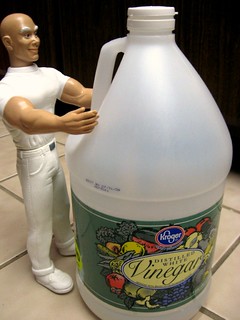
Baking soda is a natural cleaner and is often used to scrub and whiten stains. White vinegar can be used to clean through grease, to get rid of stains and even as pest control. Ants will avoid white vinegar, so if you clean around your window frames and any crevices with white vinegar, this will take care of any ant problems.

Vinegar can also be used to kill mold, clean a garbage disposal and even to take out stains left by tea and coffee in your cups. It’s also great for getting rid of lime deposits.

Salt-(sea)_B130623
Salt. (Photo credit: SoraZG)
Some other natural and organic cleaning ingredients found in green cleaners are coconut, minerals and salt. You might not think of salt as a natural cleaner, but it is. Salt can be used as an abrasive and it can also be used to dry up liquids spilled on carpets - and like vinegar, it's much cheaper than most commercial cleaning products on the market!

Look for cleaners that contain castile soap. This soap is made of natural olive oil and can be used for cleaning counter tops. It can also be used to clean clothes and it’s great on the hands. People with allergies often find it easier to use castile soap than any other type of soap.

When you’re buying organic or natural cleaners, just remember that the labels should have ingredients that you would recognize from nature. Also look for keywords like non-abrasive and non-flammable, because this is sometimes indicative of it being chemical-free.


Thursday, May 22, 2014

Safe & Natural Carpet Cleaning Tips

You’re constantly on it with and without shoes. Your kids and young family members sit on it, roll around on it and play on it. Your pets sleep on it, they chase toys on it and beg for treats on it.  You might be aware of all the activities that your carpet does handle. But you might be surprised at what hides in your carpet where you can’t see what’s going on.

You can see surface stains (and you get those up right away), but there are things in your carpet and living on the padding beneath it that you probably don’t want to know about - but you do know that you want your carpet to be clean.

the carpet needs a vaccum
 (Photo credit: Queen Of Light and Joy)
To test how clean and safe your carpet is, vacuum it once with a regular vacuum cleaner and look at the amount of debris that gets vacuumed up. Then go over it again with a vacuum cleaner designed with eco-friendly living in mind and see how much more debris is pulled up. That’s the stuff that you can’t see.

Now go over the floor again with an organic cleaner and see how dirty the water looks. That’s because no matter how many times you vacuum your carpet, no matter how powerful the vacuum, in order to stay truly clean, a carpet has to be cleaned with organic options in mind.

Using commercial cleaners to clean your carpet isn’t safe for you so you’re going to want to use natural methods. First, make sure you have a regularly scheduled vacuuming routine.

Always clean up any spills the moment they happen. You can use salt to absorb a spill, which is a natural way to keep a spill from becoming a stain. Use a damp (not wet) cloth to lighten stains like a wine spill, and then treat it with an organic stain remover.

Don’t use commercial cleaners to steam clean your carpet because the chemicals used are bad for the carpet and bad for your home - and bad for your family. Plus, by using steam cleaners, you run the risk of leaving the carpet padding wet, which can encourage the growth of natural toxins like mold and mildew.

Pets, especially cats, tend to leave a home and carpet smelling like you have pets - so use baking soda on the carpet to absorb any odors - then vacuum it up. You can also buy an organic formula just for pet stains and odors that are safer for pets than using baking soda - some animals have sensitive skin that may be irritated by baking soda.

Clean
(Photo credit: eddie.welker)
Choose a system to clean your carpets by getting a cleaning machine that has a low moisture option. By having a machine with a low moisture control, you won’t over soak the padding beneath the carpet and cause mold or mildew.

Use organic carpet cleaners that specifically state they’re for high traffic areas if that’s the carpet area you need cleaned, and make sure it states that it’s safe around pets. Some people prefer to save the expense of a carpet cleaning machine and use elbow grease instead!

Homemade carpet cleaning recipes can be as simple as a vinegar and water solution, so look for one that appeases you and start a routine that allows you to safely maintain clean and healthy carpets in your home.


Try These Natural Carpet Cleaning Products:
     
Enhanced by Zemanta

Wednesday, November 21, 2012

7 Green Ways to Unclog Your Toilet

Plugged toilets are disgusting, messy and a real pain in the neck - and something that we have to deal with more often around the holidays, often with extra family in town.  It’s so very tempting to grab a bottle of liquid drain cleaner and pour it down, hoping the clear the mess without getting your hands, or anything else, dirty. Yet that liquid drain unclogger is incredibly harmful to the environment.  The chemicals leach into our soil and taint our water supply.  Not to fret, there are easy and green ways to unclog your toilet.  Next time it becomes plugged, try one of these eight greener tricks.

English: toilet wc
(Photo credit: Wikipedia)
#1. If you’ve only flushed once and it’s apparent the toilet is plugged, turn the water off at the source so no more water can fill the tank or bowl and flush again.  Nine times out of ten this easy little trick will take care of basic toilet clogs.  Another option, if this doesn’t work, is to tap the backside of the bowl to jostle the clog. 

#2.  If step one doesn’t work then you can resort to the plunger.  Plungers release suction and like a tap to the backside of the bowl it’ll help jostle the clog.

#3.  A good old-fashioned plumber snake will also help drive a hole through the clog.  This may be especially useful with children around, as they have the uncanny ability to throw the strangest things into the toilet. A plumber snake can be purchased for about $15 to $20 dollars at the hardware store.  It’s an easy device to use - simply unwind the device using the reel type handle and let the snake work its way gradually through the clog.

#4.  Hot water.  Provided you have room in the toilet bowl, fill a bucket with very hot tap water and pour it quickly into the bowl.  This works in a number of ways.  The hot water sometimes dissolves enough of the clog to loosen it.  The change in water pressure in the tank may force the clog through, and the motion of pouring the water into the bowl may jostle the clog enough to force it through.

Non-Toxic Drain Cleaning
Non-Toxic Drain Cleaning (Photo credit: Chiot's Run)
#5.  Baking Soda.  Again, assuming the toilet bowl isn’t ready to overflow, pour one cup of baking soda and one cup of vinegar into the bowl.  This can also be followed by a gallon of hot or boiling water.  The vinegar and baking soda cause a reaction, remember volcanoes in grade school?  The reaction may work to loosen the clog.

#6. Dish soap.  Another green toilet-unclogging remedy is to pour in a gallon of boiling water and a quarter to one-third cup of dish detergent.  You’ll want to make sure it’s environmentally safe and biodegradable dish detergent for this practice to be environmentally sound.  Dish detergent works to break down the clog, just like it breaks down the dirt on your dishes. You’ll probably need to let it set for a while before the clog breaks free.

#7.  When all else fails it may be time to put on a pair of very long rubber gloves.  Ick, right?  Well it’s better than pouring caustic drain cleaner into our water supply, not to mention the dangerous fumes drain cleaners give off that can pollute the air in your home. 

Unclogging a toilet is no fun and there’s really no way to make it enjoyable, unless you’re a plumber and charging $100/hour - and even then it's probably no picnic.  Fortunately, there are a number of tried and true green ways to unclog a toilet that shouldn't make a mess, for you or the environment.


Enhanced by Zemanta