Showing posts with label Packaging and labeling. Show all posts

Tuesday, September 10, 2013

Reduce: Five Ways to Cut Down On Packaging

This month we're doing a short series on the "3 R's" - Reduce, Reuse, Recycle. Growing up surrounded by nature, even as a little kid I was very environmentally conscious. I read environmentally aware magazines, from Ranger Rick to National Geographic, created artwork on environmental themes, and pasted stickers about recycling in my notebooks and on my bedroom walls. I knew about the three "R's" from about the age of 8!

The waste hierarchy refers to the "3 Rs&q...
The waste hierarchy refers to the "3 Rs" reduce, reuse and recycle, which classify waste management strategies according to their desirability. The 3 Rs are meant to be a hierarchy, in order of importance. (Photo credit: Wikipedia)
These days recycling has become somewhat of a buzz word, but we shouldn't forget the first two - reducing your waste and reusing what you can are even more important. Recycling uses energy and can create its own waste products. So be sure you check off the first two "R's" before you move on to recycling as the last resort. (See the waste hierarchy example to the right.)  This week we're talking about the first and simplest step in terms of energy consumption and effort - reducing your consumption and production of waste.

It’s amazing how much packaging it takes to ship something.  Even something as simple as a book takes a box, shrink-wrap and something to fill the empty space between the box and the book - typically bubbles, foam peanuts or shredded paper.  Where does all this packaging go once you’ve received your item?  For most people it goes in the garbage - unless you're like me, and you save most of your packaging to use the next time you ship something (we'll talk more about reuse next week).  And we haven’t even mentioned the packaging of food and items purchased locally in your every day shopping.  Here are five ways to cut down on packaging and save resources.

#1.  Buy in bulk.  Whether you’re buying books online or cereal at your grocery, when you buy in bulk you cut down on packaging.  Think about it - if you buy one book at a time online then you’re going to receive a box for each book and all the packaging that goes along with shipping that item.  When you buy a regular box of cereal, you consume it and toss the box.  However if you buy a bulk box of cereal it may last as long as three regular boxes of cereal - you get more cereal and less packaging.

#2.  Buy from retailers who package using reusable or recyclable materials.  And when you’re shopping, use reusable or recyclable containers.  This trend is really catching on.  Stand in any grocery store line and you’ll see people shopping with reusable shopping bags - that’s an example of cutting down on packaging because you’re not taking dozens of plastic shopping bags home.  As a mail-order small business owner, I save packaging and reuse it for shipping items to our customers as much as possible. In fact, I haven't bought packing material (other than boxes) in almost 10 years!

Additionally, some retailers who manufacture and distribute processed foods are beginning to package them in reusable and/or easily recyclable containers to minimize landfill waste. And when it comes to books, why not go electronic and buy books with Kindle or another similar reader. You can even download e-books for free from some public libraries now! Not only will you reduce packaging, you'll also cut down on clutter from all those stacks of books that tend to accumulate around the house.

PackagingExceedExample
Food Packaging (Photo credit: Wikipedia)
#3.  Don’t buy prepackaged foods.  Juice boxes, for example, are incredibly useful; however, a large bottle of juice is a more sustainable practice and you can just as easily pour a serving into an aluminum water bottle for your children to enjoy.  You throw away less waste. Obviously we talk a lot here about the impacts of processed foods on your health, and the importance of preparing your own meals at home, so this is just another reason to learn to cook from scratch yourself! When it comes to groceries, shop as much as possible at local farmer's markets and CSA programs - not only will you be consuming much better quality food, but you'll drastically cut down on packaging materials.

#4.  Buy used.  Used products rarely come packaged.  You just pick them up as is from the store.  No packaging, no waste. And you can often save quite a bit of money as well.

#5.  Barter and/or trade items rather than shopping.  Bartering and trading for products is a great way to save money and conserve resources.  Many people are forming book swap groups to save money and materials by simply sharing books.  And some people are banding together to share clothing and other items. This can also be a fun way to connect with other like-minded individuals, which is important in helping you feel connected and supported in your community.

Packaging does more than fill landfills; it costs money and resources to produce - and even to recycle.  When you take a few simple steps to cut down on packaging you’re having a significant effect on your environment.  You’re making it a better place to live for you and for future generations. 

Enhanced by Zemanta

Wednesday, December 5, 2012

How to Make Kids’ Lunchboxes Waste-Free

We talked about safety issues with lunchboxes on Monday, but what about making your lunch containers safe AND environmentally friendly? When we think of school lunches, many of us picture a brown bag containing a paper napkin, a sandwich on store-bought bread in a plastic baggy, a box of juice or milk, and perhaps a piece of fruit and a plastic-wrapped cake or cookie.

A lunch sits on a blue tablecloth with a brown...
(Photo credit: Wikipedia)
What we probably don't picture are landfills heaped with non-biodegradable plastic packaging and brown paper bags that were not recycled. Let's take a new look at the portable kids' lunch and find ways to make it less wasteful, along with keeping your kids safe.

1. Lunch box not bag

Not only is a reusable lunchbox (see Monday's post for some safe options) or insulated bag more environmentally friendly, but it provides a convenient container and carrier for the reusable containers and flatware your child will be bringing back home.

2. Reusable containers

Remember the thermos you used as a child? Filling a thermos with a cold drink is less wasteful than juice boxes, bottles of water, cartons of milk, or other convenience-packaged beverages. Refillable glass, stainless steel or hard plastic water bottles are another great option.

Covered glass containers or the thermos are good for hot or cold foods - chopped fruit, potato salad, or green salad are good cold options for such containers. Warm food suggestions are pasta, soup, or some of those wonderful dinner-leftovers.

3. Cloth napkins

These are not expensive and come in a wide range of designs. Let your child personalize his or her lunch with a unique napkin. Choose cloth napkins that can be washed with your regular laundry.

4. Do away with plastic straws and flatware
Straws are really not necessary, especially if you are using a refillable water bottle. Go ahead and pack whatever forks and knives you normally use at the table, or get a special set for your child's lunchbox. Since you'll be packing your kids' lunch in a reusable lunch bag, it's a simple matter for the flatware to be put back in the bag, brought home and washed.

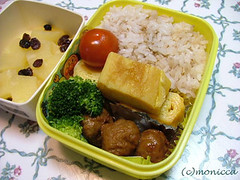
Lunch box for January
Lunch box for January (Photo credit: monicca)
5. Home-made food

Remember the store-bought bread mentioned in the beginning? It undoubtedly came in a plastic bag or packaging. Making your own bread is not only healthier - it's cheaper and saves on throw-away packaging. And it's much more delicious as well! The same goes for the meals you pack. If you have to open a can or open a package to prepare their lunch, that's one more thing you will be throwing away.

Store-bought cakes and cookies, canned pasta or soup, and bags of chips are some suggestions of waste-producing items you can make yourself or dispense with altogether - the homemade versions will be tastier AND much healthier too!

6. Sandwiches

How do you pack this old lunch stand-by without plastic baggies? There are all sorts of reusable containers available that are just right for a sandwich. Flat containers with tight covers in hard plastic or glass are a great solution. They are widely available, washable, and they keep the sandwich from getting squished.

Lunch time does not have to be waste time! These tips should help you pack a healthier and more environmentally friendly lunch for your kids.


Enhanced by Zemanta