Showing posts with label gas saving tips. Show all posts

Wednesday, August 27, 2014

3 Carpooling Tips to Save Fuel

The concept of carpooling has been around since World War II. However, formal car-pooling structures, including HOV lanes and public transportation, have been around for about forty years.  Whenever our country begins to recognize a shortage of resources, we begin taking active measures.  Here are a few tips to save fuel by carpooling:

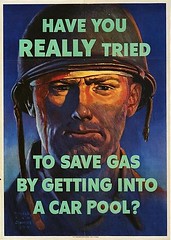
Swap Riding - NARA - 534275
Swap Riding Poster from the 1940's. (Photo credit: Wikipedia)
#1. Find other carpoolers.  This may seem initially like the hardest part of your initiative.  However, there are many ways to find people just like you to pool with.  First, check with your company human resources department.  They may have a list of carpoolers on hand – people you can ride with.  Secondly, check online.  There are carpool connection sites you can register with to find the right group of people for you.

#2.  Get organized. Once you have a group of people interested in carpooling, it’s time to organize your carpool. Here’s what you need to figure out:

* How often everyone would like to carpool?  Sometimes there are days which carpooling doesn’t work for you and/or your other carpoolers.  Create a schedule.

* Who wants to drive, and how often? 

* Where and when is everyone going to meet and get dropped off? 

* What is the start date? 

* Exchange cell phone numbers and e-mail addresses so you can communicate with them if there’s a change in your schedule. You’ll lose carpool friends fast if you leave them waiting for you.

* Make sure drivers have valid licenses and auto insurance – important!

* How much does everyone contribute to the carpooling program?  Gas and tolls cost money and it is everyone’s responsibility to contribute.  Additionally, if you’re consistently taking one person’s car then contribution to oil changes and upkeep isn’t out of the question.

A permanent, separated high-occupancy vehicle ...
Car pool lanes. (Photo credit: Wikipedia)
#3.  Establish policies.  Create a system of notification if someone is off schedule, has an emergency and so on.  Additionally, you may want to set ground rules for etiquette.  While you may think some things are obvious, others may not, so it’s best to be clear and upfront.  For example, what are appropriate speed limit rules?  What about smoking, eating/drinking, or texting and chatting on the phone while driving? 

Additionally, what do you do if you want/need to kick someone out of the group?  Sometimes it just doesn’t work out.  As a group, it may be good to decide how to give someone who doesn’t follow the rules the heave ho.

Carpooling is an exceptional way to save on fuel.  Instead of five cars on the road driving to and from work, you have one car on the road and you also save one fifth of the expense.  In addition to saving money and natural resources, you may also find you make some lifelong friends, or at least have some interesting experiences!


Thursday, June 26, 2014

Drive Smart: 8 Gas-Saving Driving Tips

As the price of gas begins to rise again and the threat of limited supply hangs over our heads, many people are looking for smart gas saving alternatives - especially with summer travel season at hand.  Here are a few handy tips to keep your fuel usage at a minimum throughout the summer road-trip season and beyond.

Speed Limit 55 sign
(Photo credit: Wikipedia)
1. Slow down or speed up.  The optimal speed limit for gas preservation is actually the 55 mph speed limit on most state highways.  Of course that doesn’t mean if the speed limit is 25 that you should go 55, or if the speed limit is 75 you should drive 20 mph under the speed limit.  However if the posted speed limit is 55, go for it and take pride in the fact that you’re saving gas.

2. Maintain your speed.  It actually uses more fuel to accelerate and brake repeatedly.  Choose your speed and stick to it as much as possible. If you have cruise control on your vehicle, this makes it easy to maintain a consistent speed, which is also very useful on long road trips.

3. Accelerate slowly.  The lead foot syndrome is a sure-fire gas waster.  When you press on the gas hard you’re releasing vast amounts of fuel.  Your engine can only burn so much and all the extra simply goes to waste. Some newer cars have an efficiency gauge to tell you how efficiently you are driving, but if yours doesn't, you will need to learn to shift up smoothly through the gears and let your car accelerate naturally. Learn where your car shifts into the next gear, and if you're driving an automatic, slowly accelerate to this speed, then let up slightly on the pedal to shift to the next gear, and repeat. Once you learn how to do this well, this will maximize your fuel efficiency.

4. Drop the weight.   Did you know that for every extra 100 pounds in your car you lose 2% in fuel efficiency.  Hop into that trunk or hatchback of yours and pull out all the extra junk.  Leave the jack and the spare tire of course!  However, that bag of workout clothing you’ve had sitting in the back for months and the empty picnic cooler can go.

5. Change your spark plugs and keep your car in tip-top shape.  The more efficient your car’s systems the more efficiently it uses fuel.  In fact, changing your old spark plugs if they're worn out can boost fuel mileage up to 30%. 

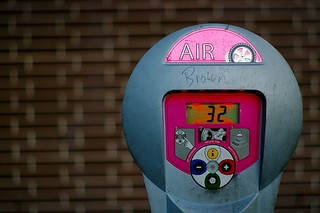
broken air
(Photo credit: greg.turner)
6. Make sure your tires have enough pressure.  Underinflated tires cause a significant reduction in fuel efficiency, since you will have more resistance on the road. 

7. Change your air filter.  Your air filter feeds the air directly into your engine and if it’s dirty you’re losing performance.  Typically, your air filter is changed when your oil is changed; however, it’s important to make sure. 

8. Close or open the windows. There’s an age-old dilemma regarding which is more fuel efficient: to drive with the air conditioner running or to drive with the windows open. The truth is that both waste fuel and are relatively equal.  However, if you’re driving at high speeds the air conditioner may save a bit more gas and if you’re driving at low speeds then having the windows open is slightly more fuel-efficient.

Ultimately, the most fuel-efficient thing you can do is to carpool, take public transportation, walk, or ride your bike.  And the smaller the vehicle you’re in, the more fuel efficient it tends to be.  Try adopting one gas saving habit each week or month until you’re not only saving the environment and conserving resources, you’re saving hundreds of dollars each month! And before taking off on vacation this summer, be sure to take these factors into account, and save some money on your vacation travel.


Friday, September 14, 2012

Handy Car Features That Minimize Gasoline Usage

The quest for relief from oppressive gas prices have led drivers on searches far and wide for ways to minimize the effect of the high prices on their wallets.  However, many drivers are literally at arm’s length from ways to help themselves, and do not even know it!  In fact, many features that come standard with new vehicles are not only convenient, but can help you to save on gas usage as well.

Since every gallon counts at today’s gas prices, even the simplest improvements to gas mileage can lead to more money in your pockets.  Although many products make gaudy claims to improve gas mileage drastically, most (if not all) of these claims are unproven.  As usual, the best remedies are usually the simple and somewhat obvious ones.  For instance, use your car’s already existing features to ease up on your gas usage when you are driving around from place to place.

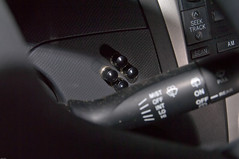
Yaris Cruise Control
Yaris Cruise Control (Photo credit: nebarnix)
Cruise control is a great feature for many reasons.  It can keep you from having to glance down at your speed all the time, for one thing.  This means that you can avoid getting a speeding ticket by merely setting a consistent speed that will not get you pulled over.  Using the cruise control feature effectively takes away any chance of you accidentally getting a heavy foot and an unintended speeding ticket as a result. 

However, cruise control is also a great way to conserve gas!  When you are on the highway, the cruise control can help your car to stay at a consistent speed.  This means that you will not be accidentally increasing your speed and making the car periodically work harder. 

If you have an “overdrive” option for your car, you should use the overdrive gears whenever possible.  Overdrive allows your engine to work much less than it would otherwise.  Of course, the less your engine works, the less gasoline you use.  In other words, overdrive alone will increase your vehicle’s fuel efficiency. 

While you are at it, keep your eye on your RPM gauge, especially if you drive a manual transmission automobile - but you can learn to use this in an automatic car as well.  After all, any time your car is running in the high end of the RPM range, you are using more engine power than you need to, and thus more gas.  Make sure that you are not staying in the low gears for too long before shifting, and spend as much time in the comfortable RPM range of higher gears as you can, since you will save yourself some gas in the process.  The RPM gauge is another example of an under-utilized feature that, if used correctly, can help you to conserve gas. (In an automatic transmission car, with a little practice, you can learn to use the gas pedal to shift gears smoothly and work your way up into the higher gears sooner.)

English: 'Symbol of Air conditioning in a BMW ...
Symbol of Air conditioning in a BMW car. (Photo credit: Wikipedia)
While we are talking about features to use, let’s also mention a feature that you should stay away from if you are trying to conserve gas: the air conditioning feature.  If you turn on your car’s air conditioning, your car will end up working much harder than usual, which means your car will consume more gas to fuel that work.  The easy translation here is to avoid the air conditioning whenever you can.  After all, it may be hot out, but you definitely do not want to have to sweat it out while pumping gas into your empty tank, right? Whenever the weather is cool enough, crack the windows a bit and enjoy the breeze - and save money on gas.

As you can see, there are many fairly basic features your car may already have that, with regular use, can help you go longer between trips to the gas station.  Even though some of these features may only have a small effect on your car’s gas usage, if you follow all of the tips, it will add up.  With gas prices as high as they are now, even if you can save a gallon or two here and there, that can be a pretty substantial savings for you!

Enhanced by Zemanta

Wednesday, September 12, 2012

4 Little-Known Ways to Improve Fuel Economy

There is not a single driver among us who would not prefer to spend less of their hard-earned cash at the fuel pump.  That is why people are becoming more and more aware of the many simple and cost effective ways that they can improve their fuel economy.  However, what do you say to people who are already familiar with the basics?  Fortunately, there are many little known ways that you can improve your gas mileage.

English: Steady speed fuel economy 1997 study
Steady speed fuel economy 1997 study (Photo credit: Wikipedia)
Just about everyone knows that if you want to save gas, you need to drive slower.  By now that's pretty much common sense. But even though you can save a lot of gas by going slower on the highway, many people are unwilling to do so. So what are some ways to increase gas mileage without having to do things that you are not willing to do in the long term?

1. First of all, stop neglecting the regular maintenance that your car needs.  According to studies, a dirty air filter can cost you up to 20% of the gas mileage you should be receiving.  A quick change of spark plugs can increase your fuel economy by over 10%.  Also, many people are not aware that they can increase their gas mileage simply by keeping their tires properly inflated!

2. Similarly, too many drivers are carting around a vehicle full of unnecessary things that are robbing them of valuable gas mileage.  For every 250 pounds of excess gear in your car, you can count on around one mile per gallon lost.  Also, make sure that you take bike racks and other items off of your vehicle when it is not the proper season.  It may take a few minutes, but such items produce extra wind resistance, which makes your vehicle work harder to accelerate or maintain speed.

3. You can even save some money on gas while you’re spending money- at the gas pump, that is.  For example, when the auto shut off kicks in, do not squeeze in a couple of extra cents to make the dollar amount even.  This is one of the ways in which people waste money, since most of that extra gas will not end up properly going in the tank.  Also, most drivers are unaware that a loose gas cap can not only cause your “service engine” light to go on, but can also result in lost gasoline, which escapes as vapor out of the tank.

English: EPA fuel economy and environmental co...
EPA fuel economy and environmental comparison label for the 2011 Chevrolet Volt (Dual fuel vehicle electricity-gasoline) (Photo credit: Wikipedia)
4. Finally, make sure that you use your car’s features to their maximum effect.  You can save a little money on gas by using your cruise control often, since your engine will not be working to match the fluctuations in pressure that you are putting on the gas pedal.  Also, make sure that you use the overdrive function when possible, since it allows your engine to avoid overworking itself.

Driving and maintaining your vehicle in a way that allows for increased fuel economy is mostly a matter of having the proper knowledge, then putting that information to work.  It is vital that you not only know the methods for increasing gas mileage, but that you are consistent in their implementation, as just trying one of these tips once or twice isn't likely to make a significant difference in your fuel efficiency - you need to make it a habit.
Enhanced by Zemanta

Wednesday, October 26, 2011

What Are the Most Fuel Efficient Vehicles?

As a follow-up to Monday's post, here is a list of the most efficient gas-powered cars in the various car classes. New innovations in fuel efficiency are happening all the time, so hopefully this list will soon grow much longer (and higher in efficiency). Be sure to check back Friday when we will discuss one particularly promising innovation that could greatly increase the mileage numbers for just about any car out there.

Honda Insight BackImage via Wikipedia1. Most efficient overall - Honda Insight hybrid
With 60 mpg city and 66 mpg highway, the Honda hybrid has top honors as most fuel efficient in the United States.  With a 1.0 gas engine mated to an electric motor, the insight was designed to make the most of the power by using low resistance tires.  The bad things about the Insight include a cramped interior, seating for two, and a very odd exterior styling, which some find unappealing.

2: Most fuel efficient mid size car - Toyota Prius hybrid
(60 mpg city and 51 mpg highway)
The Prius, unlike the Honda Insight, is capable of carrying 5 people plus their gear.  The Prius will generate a total of 110 HP from its gasoline engine and electric motor.  The sleek shape to the Prius has a low co-efficient drag although Toyota has managed to do this with a larger, yet more driver friendly vehicle than the Insight.

3. Most efficient compact car - Honda Civic hybrid
(49 mpg city and 51 mpg highway)
With a reputation of being the cheapest hybrid in North America, the Civic hybrid takes the great design of the regular Civic and makes it a lot more efficient.  With an output of 110 HP, the Civic hybrid is very competitive for the class. 

Prior Design VW New Beetle GT3 Front Bumper Bo...Image by Prior Design NA (priordesignusa.com) via Flickr4. Most efficient sub compact car - Volkswagon diesel
(37 mpg city and 44 mpg highway)
The Volkswagon Beetle diesel is ahead of even the sub compact hybrids.  Making 100 HP, the Beetle diesel may not sound that powerful, although the 177 lb-foot of torque will put shame on every other vehicle in the same class. 

5. Most efficient station wagon - Pontiac and Toyota
(30 mpg city and 36 mpg highway)
The Pontiac Vibe and Toyota Matrix are both the result of a joint venture of Toyota and General Motors.  Both vehicles come equipped with Toyota engines, although a lot of the design and engineering came from General Motors.  Both the Matrix and the Vibe are versatile with active lifestyles.  With a fuel efficient 1.8L 4 cylinder that produces 126 HP, the Matrix and the Vibe aren't going to win a street race although they make up for it with smoothness, efficiency, and refinement.

6. Most efficient large car - Hyundai Sonata
(24 mpg city and 34 mpg highway)
The Sonata is a major surprise, beating out very stiff competition.  The 2.4L 4 cylinder engine is very smooth, responsive, and powerful.  The suspension however, is soft, and geared more towards comfort than handling.  This isn't a BMW, although the build quality is great, clearly demonstrating that Hyundai is no longer a second rate manufacturer.
Enhanced by Zemanta

Friday, January 21, 2011

Free Ways to Increase Your Gas Mileage

Companies are well aware that consumers are desperate to reduce their fuel consumption.  That is why the market has been flooded with products that supposedly increase your gas mileage significantly.  Let’s ignore the fact that none of these products’ claims have been proved by the Environmental Protection Agency for a minute.  It really does not matter either way, because the fact is that there are plenty of ways to increase your gas mileage without having to spend a dime!

Tire Pressure CheckImage by Abhi Here via FlickrIt is rather unfortunate that many of these extremely easy ways to increase gas mileage are still unknown by much of the general public.  The gas prices and their constant increases have caused the economy to sputter, and have put a lot of pressure on lower and middle class families.  It is important for these folks, along with everyone else that drives regularly, to know that they can save on their gas costs without making any extra financial investment!

Many of the methods for increasing gas mileage are quite simple.  For instance, did you know that having the proper level of air pressure in your tires can help you to save gas?  It is true!  Best of all, most gas stations and even car washes have free air machines that will help you to monitor and adjust your tire pressure according to whether it is a bit high or low.

You can also increase your gas mileage by avoiding certain things while driving.  For instance, you can avoid using the air conditioning system in your vehicle, since air conditioning makes your engine work harder, which in turn means that you use more gas.  At the same time, you can drive with the windows up on cold days, which will also improve your aerodynamics, and thus, your gas mileage.  Open windows increase drag, which causes resistance that your car must overcome, after all.

A typical speed limit sign in the United State...Image via WikipediaAnother great tip for increasing gas mileage without spending a penny is simply to slow down a bit on the highway.  If you stay at the speed limit for most highways (55 miles per hour), you will be operating your vehicle at right around the optimum speed for maximum fuel efficiency.  Any faster than that, and you will be sacrificing fuel efficiency to get to where you are going just a little bit earlier. (It is estimated that every additional 5mph over this speed costs you 10% of your fuel efficiency.)

You should avoid doing certain other things, as well, such as idling your engine while you run errands or buy items at the store.  It is always better for your gas mileage for you to turn off the engine when you are stopped, even if you are only going to be gone for a couple of minutes.  You are wasting gas if you leave your car running, since you have no need for it to be running when you are not going anywhere!  You also do not need to “warm your car up” in the winter, as the only way to truly warm an engine up is by driving.  If you want it to be warm inside when you get in, try to limit the amount of time you warm up the interior of the car, at least.

These are just a few of the free methods for increasing fuel efficiency.  Try these ideas, and see how well they work for you!

Enhanced by Zemanta

Wednesday, January 19, 2011

How to Organize a Car Pool to Reduce Gas Expenses

Today we are continuing our topic this week - ways to save gas (remember, saving gas not only saves you money, but also helps the environment, and the people who live in it!)

Filling stationImage by Wildebeast1 via FlickrWho would not want to spend less money at their local gas station every week?  It would be hard to find someone who is not interested in conserving gas, but doing so is much harder than it would seem to be, at times.  One of the most obvious ways to reduce fuel expenses is to simply not drive, but for many people, that is really not feasible.  After all, most people have responsibilities that require them to be at specific places at certain times, and this in turn requires them to operate a motor vehicle to get there.

However, many people are not taking advantage of the somewhat popular practice of car pooling.  Car pooling has been around for years now, and while it has steadily increased in popularity, it still is not as widely used as it should be.  The reasons vary, as some people simply prefer to drive by themselves to and from places, and others do not know anyone that lives near them, or do not want to coordinate a regular car pool.  The reality is, however, if you want to save money on gas, there are few better ways to do so than by participating in a car pool.

Organizing a car pool can be fairly simple.  For instance, it can be as easy as posting a sign up at your work, or asking around to see if anyone who shares your place of employment lives near you.  If they live along your route to work, you can also simply pick them up every day, in exchange for a little monetary contribution towards the expense of gas.  This will not cause you any major inconvenience, but it will save you a lot of money spent on fueling up your car each week!

Example of an American grocery store aisle.Image via WikipediaMany people only think of car pooling as a way to get to and from work, but there are many other times when a car pool is an equally great idea.  For instance, you can form a car pool with people that live near you for things such as going to the gym, shopping at the grocery store, or heading out to the mall.  If you are planning on taking a vacation, it can be a very expensive endeavor, especially if you will be driving.  However, if you pair up with a couple that you enjoy being around, you can all take one car and cut your gas costs literally in half!

It may not always be convenient to car pool, but the barriers are usually not that serious.  What you really have to consider is whether it is worth it to you to have the comfort of driving in silence and solitude, even if it means that you will pay the full cost of gas all by yourself.  Most people would rather have a little company, all while saving some money at the fuel pump.  That is why car pools continue to be a fairly common thing, even to this day.  If you have never tried car pooling before, give it a shot!  With gas prices being so high, there really has never been a better time than now to give car pooling a chance.  You never know, you may even enjoy the company and make a new friend or two!
Enhanced by Zemanta

Monday, January 17, 2011

Easy Methods of Saving Gas

Gas prices are a hot topic once again these days, as they have once again begun an upward climb.  Many drivers are understandably frustrated, as they are being squeezed hard by the high prices, and seem to have no way to make gas more affordable for themselves.  Since it may be foolish to expect a drop in gas prices anytime soon, one of the best ways to deal with the ridiculous price of gas is to look for whatever ways you can to reduce your gas usage.

San Francisco, CaliforniaImage via WikipediaMany of the best methods for reducing gas usage are also among the very easiest!  This is very fortunate for those who do not have mechanical expertise or extra money to invest in products that make exaggerated claims of increased fuel efficiency.  If you number yourself among the many that are growing tired of spreading themselves thin because of gas prices, take a look at some of these very simple and free ways to free yourself of some of the cost of gas.

Of course, it is obvious that when you do not drive your car, you use no fuel, which is easily the most affordable option of them all.  However, if your car stays parked at home, so do you!  (At least in areas with insufficient public transportation as well as walking friendly neighborhoods - which sadly, is most of America....) What are the alternatives when you have places to go and people to see?  Well, a car pool is a great option, if you can make it work.  Car pools have been around for years and are quite common.  With a car pool system, you can reduce your impact on the environment while you also reduce the impact of gas prices on your wallet!

Car PoolImage by Mike Licht, NotionsCapital.com via FlickrMost people think of car pools as a way to get to work, but if you know someone who lives near you that has other places to go, you can still car pool!  If you have to go to the mall, for instance, check and see if one of your neighbors wants to go, as well.  Maybe next time, they will return the favor.

Smart trip planning is another weapon that consumers have to fight the roaring albatross that is gas prices.  To swing this deadly blade and slay the beast, simply plan ahead when you go out to make sure that you consolidate all of your shopping and errand-running needs into one trip.  If you live in a small town and must take the highway to get shopping done, it is even more important to plan your trips well to avoid excess driving!

One big “no-no” that is easily avoided is leaving your car’s engine on when you are not going anywhere.  This can include when you run in quickly to the store or gas station, or when you are waiting for a friend to come outside so you can go somewhere together.  In most cases, it will make much more sense to simply turn your engine off.  If you are not currently moving, there is really no reason to have your engine on.

Finally, avoid having excess weight in your car when you are driving around.  This means that you do not want to leave items that you do not need in your car for long periods of time, particularly if they are somewhat heavy.  This also means that you probably want to make friends with very light people!  Well, that may not be true, but it is important to reduce the weight in your car, since every 100 pounds can cause you a loss of 1 or 2 percent of your fuel economy.

It is plain to see that increasing your vehicle’s fuel efficiency does not have to be a complicated or expensive process.  It is important to remember that there are alternatives to simply staying home and not driving if you want to save money on gas.  The trick is simply to be a bit smarter about where, when and how you drive.
Enhanced by Zemanta