Showing posts with label Automobile. Show all posts

Thursday, June 26, 2014

Drive Smart: 8 Gas-Saving Driving Tips

As the price of gas begins to rise again and the threat of limited supply hangs over our heads, many people are looking for smart gas saving alternatives - especially with summer travel season at hand.  Here are a few handy tips to keep your fuel usage at a minimum throughout the summer road-trip season and beyond.

Speed Limit 55 sign
(Photo credit: Wikipedia)
1. Slow down or speed up.  The optimal speed limit for gas preservation is actually the 55 mph speed limit on most state highways.  Of course that doesn’t mean if the speed limit is 25 that you should go 55, or if the speed limit is 75 you should drive 20 mph under the speed limit.  However if the posted speed limit is 55, go for it and take pride in the fact that you’re saving gas.

2. Maintain your speed.  It actually uses more fuel to accelerate and brake repeatedly.  Choose your speed and stick to it as much as possible. If you have cruise control on your vehicle, this makes it easy to maintain a consistent speed, which is also very useful on long road trips.

3. Accelerate slowly.  The lead foot syndrome is a sure-fire gas waster.  When you press on the gas hard you’re releasing vast amounts of fuel.  Your engine can only burn so much and all the extra simply goes to waste. Some newer cars have an efficiency gauge to tell you how efficiently you are driving, but if yours doesn't, you will need to learn to shift up smoothly through the gears and let your car accelerate naturally. Learn where your car shifts into the next gear, and if you're driving an automatic, slowly accelerate to this speed, then let up slightly on the pedal to shift to the next gear, and repeat. Once you learn how to do this well, this will maximize your fuel efficiency.

4. Drop the weight.   Did you know that for every extra 100 pounds in your car you lose 2% in fuel efficiency.  Hop into that trunk or hatchback of yours and pull out all the extra junk.  Leave the jack and the spare tire of course!  However, that bag of workout clothing you’ve had sitting in the back for months and the empty picnic cooler can go.

5. Change your spark plugs and keep your car in tip-top shape.  The more efficient your car’s systems the more efficiently it uses fuel.  In fact, changing your old spark plugs if they're worn out can boost fuel mileage up to 30%. 
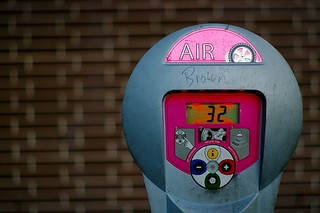
broken air
(Photo credit: greg.turner)
6. Make sure your tires have enough pressure.  Underinflated tires cause a significant reduction in fuel efficiency, since you will have more resistance on the road. 

7. Change your air filter.  Your air filter feeds the air directly into your engine and if it’s dirty you’re losing performance.  Typically, your air filter is changed when your oil is changed; however, it’s important to make sure. 

8. Close or open the windows. There’s an age-old dilemma regarding which is more fuel efficient: to drive with the air conditioner running or to drive with the windows open. The truth is that both waste fuel and are relatively equal.  However, if you’re driving at high speeds the air conditioner may save a bit more gas and if you’re driving at low speeds then having the windows open is slightly more fuel-efficient.

Ultimately, the most fuel-efficient thing you can do is to carpool, take public transportation, walk, or ride your bike.  And the smaller the vehicle you’re in, the more fuel efficient it tends to be.  Try adopting one gas saving habit each week or month until you’re not only saving the environment and conserving resources, you’re saving hundreds of dollars each month! And before taking off on vacation this summer, be sure to take these factors into account, and save some money on your vacation travel.


Wednesday, January 16, 2013

Building A Solar-Powered Car?

If water as a green energy source can be used to power a car, as we discussed in Monday's post, why don’t we do the same for solar power which has been around much longer?

Almost all cars are still powered by gas. But with the volatility of crude oil prices and because it is not a renewable resource, something must be done before it is too late. Given that solar energy, a green energy source, can be used to power entire communities, why not do this on a small scale by using the same principles to build your own car?

A modern solar cell
A modern solar cell (Photo credit: Wikipedia)
To make this work, you'll need lot of things but the two most important are the solar array and the batteries.

The solar array is vital because this is what’s used to collect the sun’s rays and convert them into electrical energy. There are two types to choose from in the market - namely the prefabricated type and the individual kind which you set up yourself.

If you are looking for branded parts, check out either Siemens or ASE Americas that sell terrestrial grade cells and space grade cells. The lower end model, which can still produce a significant amount of power, is the terrestrial grade version.

Proper wiring must be done to make sure that if one of the panels is not working, your vehicle will still move. Even if the voltage of the solar array doesn't exactly match the system voltage of your motor, in most cases it should still run.

We mentioned earlier that the battery is also important because this is where the solar energy will be stored. Your options for this are lead acid, lithium-ion or nickel-cadmium. Just how many you need to buy will depend on your motor’s voltage. 

When you finally have these two components, these will now have to be connected to the motor. And so that you know how much juice is left in your batteries, you will also need to install instrumentation similar to the heads up display console on regular cars which tells you your speed, mileage and gas.

Australia hosts the World Solar Challenge wher...
Australia hosts the World Solar Challenge where solar cars like the Nuna3 race through a km (0 mi) course from Darwin to Adelaide. (Photo credit: Wikipedia)
Interestingly enough, the only commercially available cars that use solar energy so far are the ones used in long distance races, for example, in Australia. To help people realize that renewable energy is really the key to the future, the big automakers should try tapping this technology instead of relying of still relying on gasoline.

Apart from solar energy as a green energy source to power your car, biodiesel is another alternative. This is a combination of alcohol like methanol and a chemical process that separates glycerine and methyl esters (biodiesel) from fats or vegetable oils. This can also be done using corn and sugarcane.

Not only are these renewable, but they don't release the same pollution into the atmosphere that a gasoline engine does. This means you do not release harmful chemicals such as carbon monoxide into the air which causes damage to the environment. So even if you can’t build a solar powered car, at least consider a different fuel alternative.


Enhanced by Zemanta

Monday, January 17, 2011

Easy Methods of Saving Gas

Gas prices are a hot topic once again these days, as they have once again begun an upward climb.  Many drivers are understandably frustrated, as they are being squeezed hard by the high prices, and seem to have no way to make gas more affordable for themselves.  Since it may be foolish to expect a drop in gas prices anytime soon, one of the best ways to deal with the ridiculous price of gas is to look for whatever ways you can to reduce your gas usage.

San Francisco, CaliforniaImage via WikipediaMany of the best methods for reducing gas usage are also among the very easiest!  This is very fortunate for those who do not have mechanical expertise or extra money to invest in products that make exaggerated claims of increased fuel efficiency.  If you number yourself among the many that are growing tired of spreading themselves thin because of gas prices, take a look at some of these very simple and free ways to free yourself of some of the cost of gas.

Of course, it is obvious that when you do not drive your car, you use no fuel, which is easily the most affordable option of them all.  However, if your car stays parked at home, so do you!  (At least in areas with insufficient public transportation as well as walking friendly neighborhoods - which sadly, is most of America....) What are the alternatives when you have places to go and people to see?  Well, a car pool is a great option, if you can make it work.  Car pools have been around for years and are quite common.  With a car pool system, you can reduce your impact on the environment while you also reduce the impact of gas prices on your wallet!

Car PoolImage by Mike Licht, NotionsCapital.com via FlickrMost people think of car pools as a way to get to work, but if you know someone who lives near you that has other places to go, you can still car pool!  If you have to go to the mall, for instance, check and see if one of your neighbors wants to go, as well.  Maybe next time, they will return the favor.

Smart trip planning is another weapon that consumers have to fight the roaring albatross that is gas prices.  To swing this deadly blade and slay the beast, simply plan ahead when you go out to make sure that you consolidate all of your shopping and errand-running needs into one trip.  If you live in a small town and must take the highway to get shopping done, it is even more important to plan your trips well to avoid excess driving!

One big “no-no” that is easily avoided is leaving your car’s engine on when you are not going anywhere.  This can include when you run in quickly to the store or gas station, or when you are waiting for a friend to come outside so you can go somewhere together.  In most cases, it will make much more sense to simply turn your engine off.  If you are not currently moving, there is really no reason to have your engine on.

Finally, avoid having excess weight in your car when you are driving around.  This means that you do not want to leave items that you do not need in your car for long periods of time, particularly if they are somewhat heavy.  This also means that you probably want to make friends with very light people!  Well, that may not be true, but it is important to reduce the weight in your car, since every 100 pounds can cause you a loss of 1 or 2 percent of your fuel economy.

It is plain to see that increasing your vehicle’s fuel efficiency does not have to be a complicated or expensive process.  It is important to remember that there are alternatives to simply staying home and not driving if you want to save money on gas.  The trick is simply to be a bit smarter about where, when and how you drive.
Enhanced by Zemanta