Showing posts with label Solar energy. Show all posts

Wednesday, January 16, 2013

Building A Solar-Powered Car?

If water as a green energy source can be used to power a car, as we discussed in Monday's post, why don’t we do the same for solar power which has been around much longer?

Almost all cars are still powered by gas. But with the volatility of crude oil prices and because it is not a renewable resource, something must be done before it is too late. Given that solar energy, a green energy source, can be used to power entire communities, why not do this on a small scale by using the same principles to build your own car?

A modern solar cell
A modern solar cell (Photo credit: Wikipedia)
To make this work, you'll need lot of things but the two most important are the solar array and the batteries.

The solar array is vital because this is what’s used to collect the sun’s rays and convert them into electrical energy. There are two types to choose from in the market - namely the prefabricated type and the individual kind which you set up yourself.

If you are looking for branded parts, check out either Siemens or ASE Americas that sell terrestrial grade cells and space grade cells. The lower end model, which can still produce a significant amount of power, is the terrestrial grade version.

Proper wiring must be done to make sure that if one of the panels is not working, your vehicle will still move. Even if the voltage of the solar array doesn't exactly match the system voltage of your motor, in most cases it should still run.

We mentioned earlier that the battery is also important because this is where the solar energy will be stored. Your options for this are lead acid, lithium-ion or nickel-cadmium. Just how many you need to buy will depend on your motor’s voltage. 

When you finally have these two components, these will now have to be connected to the motor. And so that you know how much juice is left in your batteries, you will also need to install instrumentation similar to the heads up display console on regular cars which tells you your speed, mileage and gas.

Australia hosts the World Solar Challenge wher...
Australia hosts the World Solar Challenge where solar cars like the Nuna3 race through a km (0 mi) course from Darwin to Adelaide. (Photo credit: Wikipedia)
Interestingly enough, the only commercially available cars that use solar energy so far are the ones used in long distance races, for example, in Australia. To help people realize that renewable energy is really the key to the future, the big automakers should try tapping this technology instead of relying of still relying on gasoline.

Apart from solar energy as a green energy source to power your car, biodiesel is another alternative. This is a combination of alcohol like methanol and a chemical process that separates glycerine and methyl esters (biodiesel) from fats or vegetable oils. This can also be done using corn and sugarcane.

Not only are these renewable, but they don't release the same pollution into the atmosphere that a gasoline engine does. This means you do not release harmful chemicals such as carbon monoxide into the air which causes damage to the environment. So even if you can’t build a solar powered car, at least consider a different fuel alternative.


Enhanced by Zemanta

Friday, July 27, 2012

Video - New Solar Panel Innovation

Here is an example of an innovative new design for solar panels, which will lower costs considerably, while also increasing efficiency and energy production. As we discussed on Wednesday, we should be seeing more and more of these innovations in the solar energy field in the years to come, making solar power a viable source of electricity for more and more people.

Check out this short news clip to learn more about this particular example:

New Solar Panel
Reno company Snowpeak Energy has created a next-generation solar panel at half the price of a standard panel, while producing 3 times the electricity. This story is the first time it's been photographed for the public to see. Aired 04/14/2009 KTVN Ch...

Enhanced by Zemanta

Wednesday, July 25, 2012

Solar Energy Collection Improvements

Photovoltaic cells—those black squares an array of which comprises a solar panel—are getting more efficient, and gradually less expensive, all the time, thanks to ever-better designs which all them to focus the gathered sunlight on a more and more concentrated point. The size of the cells is decreasing as their efficiency rises, meaning that each cell becomes cheaper to produce and at once more productive. As far as the aforementioned cost, the price of producing solar-generated energy per watt hour has come down to $4.00 (or less) at the time of this writing. Just 17 years ago, it was nearly double that cost.

Photovoltaic cells produce electricity directl...
Photovoltaic cells produce electricity directly from sunlight (Photo credit: Wikipedia)
Solar powered electricity generation is certainly good for the environment, as this alternative form of producing energy gives off absolutely zero emissions into the atmosphere and is merely utilizing one of the most naturally occurring of all things as its driver. Solar collection cells are becoming slowly but surely ever more practical for placing upon the rooftops of people's homes, and they are not a difficult system to use for heating one's home, creating hot water, or producing electricity. In the case of using the photovoltaic cells for hot water generation, the system works by having the water encased in the cells, where it is heated and then sent through your pipes.

Photovoltaic cells are becoming increasingly better at collecting sufficient radiation from the sun even on overcast or stormy days. One company in particular, Uni-Solar, has developed solar collection arrays for the home that work well on inclement days, by way of a technologically advanced system that stores more energy at one time during sunlit days than previous or other arrays.
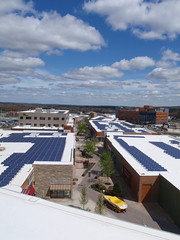
There is also another solar power system available for use called the PV System. The PV System is connected to the nearest electrical grid; whenever there is an excess of solar energy being collected at a particular home, it is transferred to the grid for shared use and as a means of lowering the grid's dependence on the hydroelectrically-driven electricity production. Being connected to the PV System can keep your costs down as compared to full-fledged solar energy, while at once reducing pollution and taking pressure off the grid system. Some areas are designing centralized solar collection arrays for small towns or suburban communities.

Solar Energy
(Photo credit: janie.hernandez55)
Some big-name corporations have made it clear that they are also getting into the act of using solar power (a further indication that solar generated energy is becoming an economically viable alternative energy source). Google is putting in a  1.6 megawatt solar power generation plant on the roof of its corporate headquarters, while Wal-Mart wants to put in an enormous 100 megawatt system of its own.

Nations such as Japan, Germany, the United States, and Switzerland have been furthering the cause of solar energy production by providing government subsidies or by giving tax breaks to companies and individuals who agree to utilize solar power for generating their heat or electrical power. As technology advances and a greater storage of solar collection materials is made available, more and more private investors will see the value of investing in this “green” technology and further its implementation much more in the years to come.


A Few Innovative New Solar Power Products:
   
Enhanced by Zemanta

Monday, April 23, 2012

The Advantages and Disadvantages of Green Energy Sources

Today, almost everyone is now becoming aware of the effects of global warming. Fortunately, it’s not too late and we can still make positive changes, which is why many are pushing for more green energy sources.

The advantage of using green energy sources is that they are cleaner so they does not emit as many harmful pollutants into the air, which creates a lesser impact on the environment. Green energy sources are also renewable which means we will never run out of them, unlike fossil fuel types such as oil, which is expected to dry up in another decade or two.

The , also known as the Green Mountain Energy ...
Green Mountain Energy Wind Farm. (Photo credit: Wikipedia)
Although green energy facilities are expensive to build, many can require less maintenance so you don’t have to shell out a lot of money to operate them in the long-term.

They can also bring economic benefits to certain areas, and in come cases even boost tourism.

While these sound good, there are some who say that there are disadvantages to using such technology.

While green energy sources can produce electricity, how much they can generate is often not consistent. This is because we have no control of the weather, for example, so if a certain area relies on solar energy and there is an unexpected weather disturbance which reduces the sun's rays reaching the earth, the system will not be able to convert sunlight into electricity.

Building these facilities also requires a lot of land so we may have to encroach on farmland or wildlife areas, which is what many are concerned about if more wind turbines are to be put up.

Another disadvantage is the fact that some of the green energy sources cannot be installed in certain areas of the planet. For instance, wave energy can only be utilized if ocean waves reach at least 16 feet. The use geothermal energy can only be done in geologically unstable parts of the planet.

But if you look at such arguments, places that cannot use one form of green energy source can usually substitute another. And if wind turbines need more space, they can be installed near the coast instead of on land. In fact, several studies show that you can generate more electricity with wind turbines planted in the ocean anyway.

While the weather is something we cannot control, most weather disturbances don't last too long, and if energy is being properly stored from a solar panel system, it should have enough backup energy to make it through a period without sun. .

The point is that there are ways around many of the arguments which discourage the use of green energy sources. In fact, research is ongoing to try and harness other means to generate the power we need, and new technologies and resources are being developed on a regular basis.

A very good example of this is called ocean thermal energy. Power is generated by harnessing the different temperatures in the water. It is currently being used on a small scale both in Japan and Hawaii.

Generation mix of Spain's Electricity supply -...
Generation mix of Spain's Electricity supply - Over 50% from renewables! (Photo credit: Tom Raftery)
In the US, only 7% of our energy comes from green energy sources currently - lagging far behind most other developed countries. We actually ranked much higher just 11 years ago and if we don’t want to have to worry about the cost of oil or even reduce our dependency on it, we really have to invest more in clean types of energy.

We can get it from green energy sources such as biomass, biodiesel, geothermal, solar, water and the wind. These are things we have all around us and all it takes is for someone to harness them instead of relying on traditional non-renewable means to produce energy. The future of our planet, and humanity, depends on us using our creativity and great brains to develop methods to utilize these resources in an efficient manner!

Enhanced by Zemanta

Friday, March 30, 2012

Video - Small Home Solar Power System Demo

Here's a short demo of one family's small home solar power system they use to power electronics in the home. While they're not completely off the grid, they are using this small solar power system to meet everyday electricity needs such as lights, television, computers, kitchen appliances, and more. Pretty cool!  If you want to learn more about solar power kits and D.I.Y. solar power info, visit the link below the video.

DIY My small home solar power system
A brief layout of my solar system that I added to my small house. This house is still hooked up to the grid. I use it to run all the lights in my home and the tv, every day. I am able to run anything up to 1000 watts if needed


Click Here to Learn More About D.I.Y. Solar Power....


do it yourself solar power kits
Enhanced by Zemanta

Monday, June 13, 2011

Resources for Alternative Energy

There are many different forms in which alternative energy is available.

On 140 acres of unused land on Nellis Air Forc...Image via WikipediaOne of these is solar power. Solar power is driven by photovoltaic cells, and these are progressively getting less expensive and more advanced. Solar energy power can be used for electricity, heating, and making hot water. Solar energy produces no pollution, as its input comes completely from the sun's rays. However, much more work still needs to be done in order for us to economically harness the sun's energy. For the time being, the resource is a little too conditional—storage batteries are needed to be used as backups in the evenings and on inclement days.

Wind energy has become the most-invested-in (by private investors and governments together) alternative energy source for the time being. The great arrays of triple-bladed windmills are being placed all over as “wind farms”, to capture the motion of the wind and use its kinetic energy for conversion to mechanical or electrical energy. Of course, there is nothing new about the concept of a windmill for harnessing energy. Modern wind turbines are simply are more advanced variations on the old theme. Of course, the drawback to wind energy is...what do you do when there is a calm, still day? Needless to say, during these times the electric company kicks in for powering your home or office. Wind energy is not altogether independent.

Icon of Wind TurbinesImage via WikipediaHydroelectric energy is available as a source of alternative energy, and it can generate a substantial amount of power. Simply put, hydroelectric energy uses the motion of water—its flow in response to gravity, which means downhill—to turn turbines which then generate electrical energy. Needless to say, water is ubiquitous; finding sources for driving hydroelectric turbines is, therefore, not much of a problem. However, hydroelectricity as a source of alternative energy can be complicated and expensive to produce. Dams are often built in order to be able to control the flow of the water sufficiently to generate the needed power. Building a dam to store and control water's potential and kinetic energy takes quite a lot of work, and operating one is complex as well,and conservationists grow concerned that it. Of course, a dam is not always needed if one is not trying to supply the electrical needs of a city or other very densely populated area. There are small run-of-river hydroelectric converters which are good for supplying neighborhoods or an individual office or home. 

Probably the most underrated and under-appreciated form of alternative energy is geothermal energy, which is simply the naturally-occurring energy produced by the heating of artesian waters that are just below the earth's crust. This heat is transferred into the water from the earth's inner molten core. The water is drawn up by various different methods—there are “dry steam” power plants, “flash” power plants, and “binary” power plants for harnessing geothermal energy. The purpose of drawing up the hot water is for the gathering of the steam.  The Geysers, approximately 100 miles north of San Francisco, is probably the best-known of all geothermal power fields; it's an example of a dry stream plant.
Enhanced by Zemanta

Wednesday, May 11, 2011

Tips for Building Inexpensive Solar Panels

Harnessing and utilizing solar energy is one of the most efficient sources for powering our homes. However, solar panels can be very expensive, and even building your own can add up to quite a bit. This short video and article gives some good tips for finding cheap solar panel parts, which you can then use to build your own.

Cheap Solar Panels – Build Quality Home Solar Panels | Green ...
www.solarpanelsquick.com – There are many different ways you can get cheap solar panels. There are dozens of websites available that can walk you through the whole process of making your own solar energy systems, with the panels being ...
Publish Date: 03/31/2011 3:00
http://coolgreenlivingtips.com/solar-energy/cheap-solar-panels-build-quality-home-solar-panels/
Enhanced by Zemanta

Monday, May 9, 2011

How to Make a Solar Space Heater

Here is a pretty cool article with step-by-step instructions for making your own solar-powered space heater, which will work great for heating a small space such as a garage or other small room in which you need a little extra heat. Unlike many expensive models on the market, this one won't cost you more than dinner for two, and only takes a few hours to put together. If you're looking to increase the efficiency of your home, or if you already have a solar-powered home but need a little extra heat somewhere, this is a great solution to try.

Have fun building, and be sure to come back and let us know how it turns out!

How to Make Solar Space Heater for Your Garage or Enclosed Porch
If you are looking to learn how to make solar space heaters then this is the tutorial for you. This is a step by step process using recycled materials to help you lower your heating bill and bring warn air into an otherwise unreachable ...
Publish Date: 04/20/2011 19:28
http://www.brighthub.com/environment/green-living/articles/114675.aspx
Enhanced by Zemanta

Friday, December 3, 2010

Video-Solar Energy Concentrator

Here is a pretty interesting video which demonstrates a simple energy concentration device using energy from the sun for a variety of purposes. It also includes some great explanations of how and why solar energy works, and how you can build a similar device.

Becoming energy independent is an important goal for living a green lifestyle that is healthy for both yourself and the planet. While this device won't solve all of our energy problems, it is great to see such interesting ideas taking shape and being used to create new opportunities for you and me.

Solar Energy Concentrator
Purchase: hilaroad.com This video demonstrates how solar energy can be focused with a curved mirror. Once focused this energy can be used to cook food, sterilize water even create electricity. Includes an explanation of Energy, Power, Joules, Watts. ...


Enhanced by Zemanta

Wednesday, December 1, 2010

Harnessing Solar Energy for Your Home

Solar energy is a natural source of energy that comes directly from the sun.  When solar energy hits the earth it spreads over the earth's surface and provides warmth evenly.  If you could capture the sun's rays into a particular area for a long period of time it would provide enough warmth for nighttime or on cloudy days.  Learning where to find solar energy can help you to get started today.  Solar energy does not cost anything because it comes from the sun.  The source that you choose may cost some but in the long run it should be your only expense, unlike gas or oil heaters that you continue to pay for monthly in order to have power or gas heat in your home. Solar power can provide heating, cooling and ventilation.

Thermal-solarImage via WikipediaIf you want to make your own solar power to capture the energy for heating its easy to do if you can find a solar collector, which is anything that attracts the heat from the sun in a concentrated amount, such as glass or clear plastic. Getting into your car that has sat out in the hot sun all day long can be extremely hot and you have to roll down your windows to cool it off inside.  That is because the glass has attracted the sun and the objects in your car, including your seats, have trapped the heat not allowing it to escape.  When you roll your windows down you are allowing the heat to escape causing your car to cool down. The same thing is true about greenhouses. The glass or clear plastic can attract the sun and not allow it to escape causing the greenhouse to maintain the heat for the plants to grow effectively. 

In order to heat your home using solar energy, you need to know the difference between a passive and an active home.  These two types of solar homes offer the homeowner options to choose from and your cost of heating may be lowered.  Solar energy can not only heat your home but also your water, and if you use solar energy lights it can light your home at night.

Passive homes do not use any equipment to heat the home.  Passive homes use windows that are made to allow the maximum amount of sunlight into your home.  The sunlight is controlled by keeping the doors and windows closed in the hottest part of the day not allowing any heat to escape. At night thick curtains may be used on these windows so that the warmth stays inside during the night.  This allows the sun to naturally heat your home without any help.

Active homes do use equipment to help circulate the heat in the home.  Some of the equipment that may be used includes pumps, blowers and an alternative heating source in case the sunlight was not enough during the daytime.  In order to heat the home with sunlight these homes use special boxes on the outside that attract the sunrays to it.  They are made from a dark colored metal to help attract the sun more. The water or air that is carried in the pipes and ductwork is heated by this glass box that has captured the sunlight.  Then the heated water or air is then carried to the rest of the home.

In the long run, solar energy helps to heat the home naturally and without depending on a company to supply it for you. Solar energy can be found anywhere the sun is.
Enhanced by Zemanta